
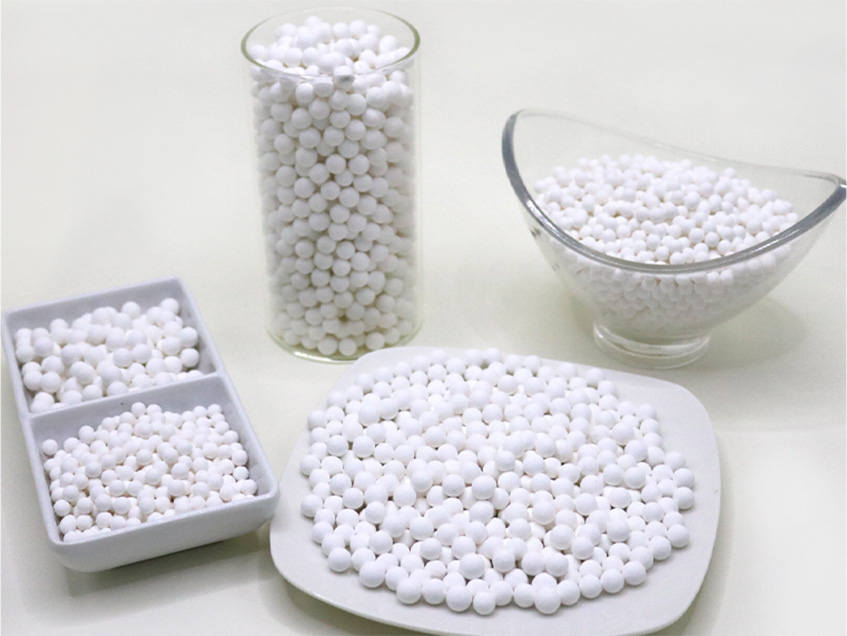
There are many types of activated alumina catalysts used in exhaust gas treatment, with various classification methods. They can be broadly categorized into acid-base catalysts, metal catalysts, semiconductor catalysts, and zeolite catalysts. Their common characteristic is that they can exert varying degrees of chemisorption on reactants. Therefore, catalysis is inseparable from adsorption, and the general catalytic process starts with adsorption.
Acid-Base Catalysts
The acids and bases mentioned here refer to acids and bases in a broad sense, namely Lewis acids and Lewis bases. Both can provide acid-base active adsorption sites for the chemisorption of reactants, thereby promoting chemical reactions.Examples include activated clay, aluminum silicate, aluminum oxide, and oxides of some metals, especially oxides or salts of transition metals.
Metal Catalysts
The adsorption capacity of metals depends on the metal itself, the molecular structure of the gas, and adsorption conditions. Experiments have shown that metallic elements with empty d-electron orbitals exhibit different chemisorption capacities for certain representative gases.Except for calcium (Ca), strontium (Sr), and barium (Ba), most of these metals are transition metals. They form adsorption bonds with adsorbate molecules through electrons or free electrons that do not participate in the hybrid orbitals of metallic bonds, thereby catalyzing reactions between reactants.
Semiconductor Catalysts
These are mainly semiconductor-type transition metal oxides, divided into n-type semiconductors and p-type semiconductors, which provide quasi-free electrons and quasi-free holes respectively.N-type semiconductor catalysts form adsorption bonds with reactants via their quasi-free electrons, while p-type semiconductor catalysts rely on quasi-free holes. The formation of adsorption bonds changes the conductivity of the semiconductor, which is one of the main factors affecting catalyst activity.
In fact, the formation of adsorption bonds between gas molecules and semiconductor catalysts is a very complex process. Studies on the catalytic mechanism of semiconductors have also found that energy bands generated by electron transitions play an important role in the formation of adsorption bonds. Therefore, it cannot be simply assumed that reactant molecules capable of donating electrons can only form adsorption bonds with p-type semiconductor catalysts.
Zeolite Molecular Sieve Catalysts
As adsorbents, zeolite molecular sieves are widely used in drying, purification, separation and other processes. They began to emerge in the field of catalysts and catalyst supports in the 1960s.Zeolite refers to natural crystalline aluminosilicates with uniform micropore diameters, hence also known as molecular sieves. Hundreds of types have been developed so far, and many important industrial catalytic reactions rely on zeolite catalysts.
The catalytic action of zeolites also depends on surface acidic sites to form adsorption bonds. However, they have higher selectivity than ordinary acid-base catalysts, as they can exclude molecules larger than their pore size from entering the internal surface. Meanwhile, the acidity and alkalinity on the zeolite surface can be artificially adjusted by ion exchange, giving them better performance than conventional acid-base catalysts.
In recent years, a class of non-silicoaluminate synthetic molecular sieves has been developed and widely used in the field of catalysis. This shows that zeolites hold a unique position and play an irreplaceable role in catalysis.
Any interestes or questions ,welcome to visit us at www.carbon-cms.com.
Please Read On, Stay Posted, Subscribe, And We Welcome You To Tell Us What You Think.

Copyright @ 2026 Chizhou Shanli Molecular Sieve Co., Ltd. All Rights Reserved.
 Network Supported
Hi! Click one of our members below to chat on