Home

PSA Nitrogen Generator

PSA Nitrogen Generator

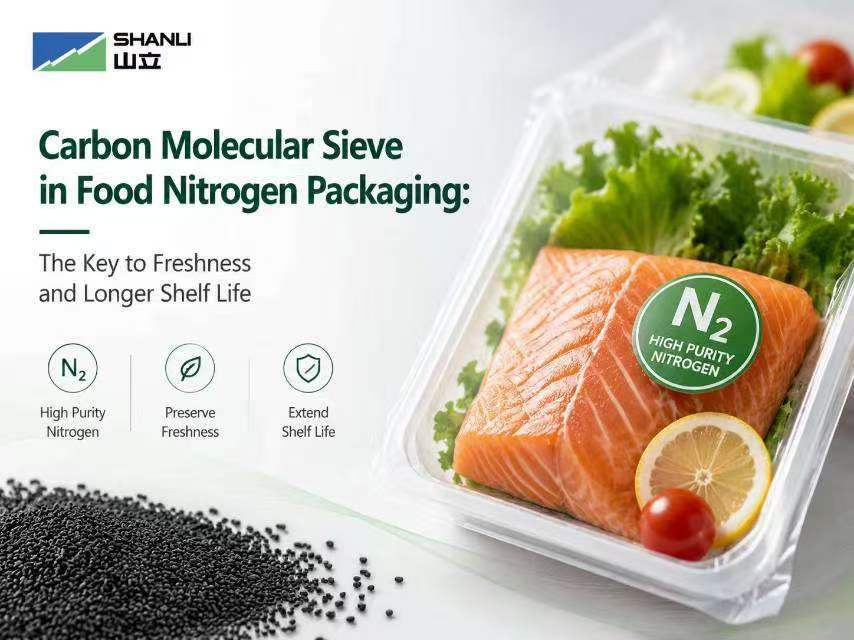
  • Carbon Molecular Sieve in Food Nitrogen Packaging: The Key to Freshness and Longer Shelf Life
    Carbon Molecular Sieve in Food Nitrogen Packaging: The Key to Freshness and Longer Shelf Life Jul 02, 2026
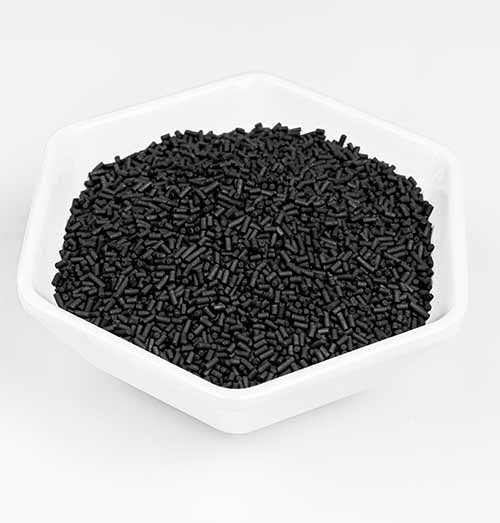
    In today's food industry, maintaining freshness while extending shelf life has become a critical challenge. Consumers expect high-quality products without excessive preservatives, while manufacturers seek cost-effective and reliable packaging solutions.   Nitrogen packaging has become one of the most widely adopted preservation technologies across the food industry. Behind this process, high-purity nitrogen generated by Pressure Swing Adsorption (PSA) systems plays a vital role—and Carbon Molecular Sieve (CMS) is the core adsorbent that makes PSA nitrogen generation possible.   This article explores how Carbon Molecular Sieve supports food nitrogen packaging and why it has become an essential material for modern food processing.     1.Why Nitrogen Is Used in Food Packaging   1.1 Air contains approximately: 78% Nitrogen  21% Oxygen  1% Other gases    1.2 Among these gases, oxygen is the primary cause of: Food oxidation  Loss of flavor  Color changes  Mold growth  Rancidity of oils  Reduced shelf life    1.3 Replacing oxygen with nitrogen significantly slows these degradation processes because nitrogen is: Inert  Odorless  Non-toxic  Dry  Safe for direct food contact    1.4 As a result, nitrogen flushing is commonly used in: Potato chips  Coffee  Tea  Nuts  Milk powder  Pet food  Dried fruits  Snacks  Bakery products      2.How Carbon Molecular Sieve Produces Nitrogen Carbon Molecular Sieve is specially engineered with uniform micropores. Inside a PSA nitrogen generator, compressed air passes through CMS beds. The CMS selectively adsorbs oxygen molecules while allowing nitrogen molecules to pass through.   2.1 The result is a continuous supply of nitrogen with purity levels typically ranging from: 95%  99%  99.5%  99.9%  Up to 99.999% depending on system design    2.2 Compared with liquid nitrogen delivery, on-site PSA nitrogen generation offers: Lower operating costs  Continuous nitrogen supply  Reduced transportation expenses  Improved production flexibility  Enhanced safety      3.Benefits of PSA Nitrogen for Food Packaging   3.1 Longer Shelf Life Lower oxygen content slows oxidation, preserving food quality for longer periods.   3.2 Better Product Appearance Nitrogen helps maintain the original color and texture of packaged foods.   3.3 Improved Flavor Retention Coffee beans, roasted nuts, tea, and snack foods retain aroma and taste much longer.   3.4 Reduced Food Waste Stable packaging environments minimize spoilage during transportation and storage.   3.5 Cost Savings Generating nitrogen on-site eliminates recurring gas cylinder or liquid nitrogen purchases.     4.Why Carbon Molecular Sieve Quality Matters The performance of a PSA nitrogen generator depends heavily on the quality of its Carbon Molecular Sieve.   4.1 High-performance CMS offers: High nitrogen yield  Fast adsorption kinetics  Excellent oxygen separation  Stable purity  Long service life  Low dust generation  Low air consumption    4.2 Poor-quality CMS may result in: Lower nitrogen purity  Higher energy consumption  Frequent replacement  Increased maintenance costs      5.Choosing the Right CMS for Food Industry Applications   5.1 When selecting Carbon Molecular Sieve for food packaging, manufacturers should consider: Nitrogen purity requirements  Nitrogen flow rate  Adsorption capacity  Mechanical strength  Service life  Dust resistance  Compatibility with PSA equipment  A reliable CMS supplier can help optimize both production efficiency and operating costs.     6.Conclusion Nitrogen packaging has become a standard preservation technology across the food industry. As the core material inside PSA nitrogen generators, Carbon Molecular Sieve enables efficient, economical, and continuous nitrogen production.   High-quality CMS not only improves nitrogen purity but also reduces operating costs and enhances the reliability of food packaging systems. Whether producing snacks, coffee, dairy products, or pet food, choosing the right Carbon Molecular Sieve is an important investment in product quality and production efficiency.  
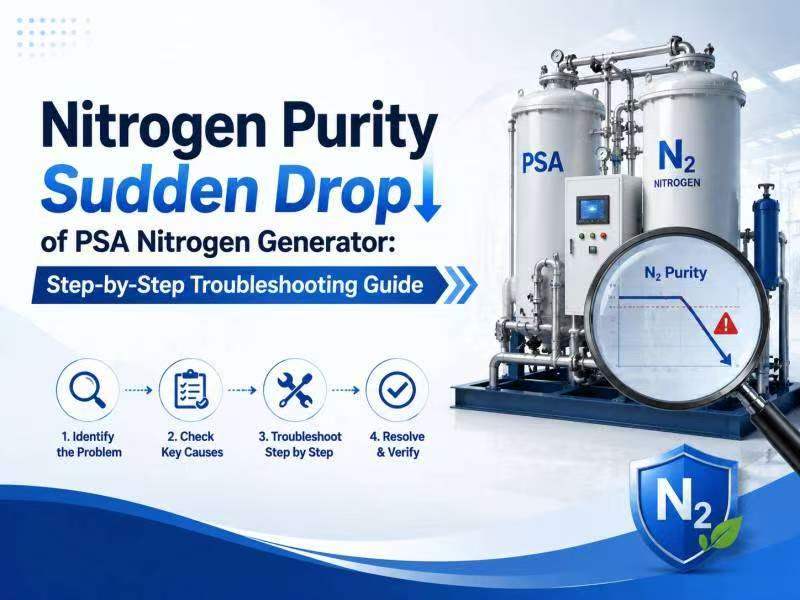
  • Nitrogen Purity Sudden Drop of PSA Nitrogen Generator: Step-by-Step Troubleshooting Guide
    Nitrogen Purity Sudden Drop of PSA Nitrogen Generator: Step-by-Step Troubleshooting Guide Jun 26, 2026
    Stable nitrogen purity is the core operating indicator of PSA nitrogen generators in industrial production. Abrupt nitrogen purity reduction is one of the most common equipment faults that disrupt normal manufacturing processes, affecting product quality, production safety and overall operation efficiency directly.   Most on-site maintenance personnel fail to locate root causes quickly when facing sudden purity drop, leading to prolonged downtime and unnecessary production losses. Combined with practical after-sales maintenance experience of PSA nitrogen production equipment, this article sorts out standard sequential troubleshooting steps covering air source pretreatment, pipeline pressure, control system, carbon molecular sieve status and adsorption tower faults. It provides a universal and efficient inspection checklist for daily equipment maintenance.   1. Primary Inspection: Compressed Air Source & Pretreatment System   1.1 Inspect Compressed Air Pressure and Air Volume Unstable air supply is the most frequent external cause of nitrogen purity decline. Check whether the outlet pressure of the air compressor meets the equipment design standard (generally 0.75-0.85MPa). Excessively low air intake pressure will weaken the oxygen adsorption capacity of carbon molecular sieve; meanwhile, insufficient air supply volume will break the normal adsorption-desorption cycle matching ratio of two adsorption towers.   Modern PSA systems increasingly rely on advanced adsorption materials such as high-performance porous carbon, which require highly stable air quality and pressure conditions to maintain optimal separation efficiency.   1.2 Check Air Dryer and Filter Working Status Moisture, oil mist and dust in compressed air are permanent damage sources to CMS. Verify the working state of refrigerated air dryer, adsorption dryer and three-stage precision filters. If the air dew point rises or filter elements are blocked and failed, oil and water will adhere to molecular sieve micropores permanently, causing irreversible attenuation of oxygen separation performance and continuous drop of nitrogen purity.   High-end systems often utilize enhanced pore volume porous carbon to improve adsorption capacity and extend operational stability under demanding industrial conditions.   2. Secondary Inspection: Pipeline System and Pressure Holding Performance   2.1 Detect Air Pipeline Leakage Check all air intake pipelines, connecting joints, valve ports and buffer tank interfaces for air leakage. Tiny invisible leaks will cause pressure loss during pressure maintaining and adsorption procedures, destroy the pressure difference required for normal nitrogen-oxygen separation, and finally result in unqualified nitrogen outlet purity.   2.2 Verify Pressure Equalization and Pressure Holding Time Check whether the pressure holding time and pressure equalization time of the PLC control system match the original factory parameters. Too short pressure holding time makes CMS fail to fully adsorb oxygen; mismatched pressure equalization parameters will cause gas cross-mixing between two adsorption towers, mixing unqualified raw air into finished nitrogen gas.   Stable system performance is especially critical when using high purity 99.9995% carbon molecular sieve, as even slight parameter deviation can significantly affect final nitrogen output purity.   3. Core Inspection: Solenoid Valves and Program Control System All adsorption and regeneration actions of PSA nitrogen generators rely on high-frequency switching of solenoid valves. Abnormal valve operation is a key electrical and mechanical fault leading to sudden purity drop: Stuck solenoid valve: Failed to switch adsorption and regeneration circulation normally Valve sealing failure: Internal gas channel cross-leakage inside the valve body PLC program parameter drift: Automatic running time sequence disorder after long-term operation Regular solenoid valve performance testing and program parameter reset can eliminate most electrical control faults rapidly.     4. Key Inspection: Carbon Molecular Sieve Filling and Adsorption Tower Status   4.1 Molecular Sieve Settlement and Gap Generation After long-term cyclic pressure impact, CMS inside adsorption towers will settle naturally and form gaps. Direct gas channeling will occur without full oxygen adsorption, which is a common mechanical fault for long-running nitrogen making equipment.   4.2 CMS Aging and Poisoning Failure Aging failure after service life expiration or oil-water poisoning caused by failed pretreatment system will damage the micropore structure of carbon molecular sieve completely. Once CMS fails to separate oxygen and nitrogen normally, nitrogen purity cannot recover even after adjusting system operating parameters.     5. Quick Troubleshooting Sequence Summary Check air compressor pressure, air volume and pretreatment dryer & filters Detect whole pipeline air leakage and system pressure holding effect Inspect solenoid valve switching action and PLC control time sequence Check molecular sieve settlement, gap and overall use status inside adsorption towers   Sudden nitrogen purity drop of PSA nitrogen generators rarely results from single fault. Maintenance staff shall follow the external-to-internal, electrical-to-mechanical, peripheral-to-core sequential inspection method instead of blind disassembly. Routine daily maintenance of air source pretreatment and regular CMS filling inspection can effectively avoid sudden purity failure and ensure long-term stable and efficient operation of PSA nitrogen production equipment.  
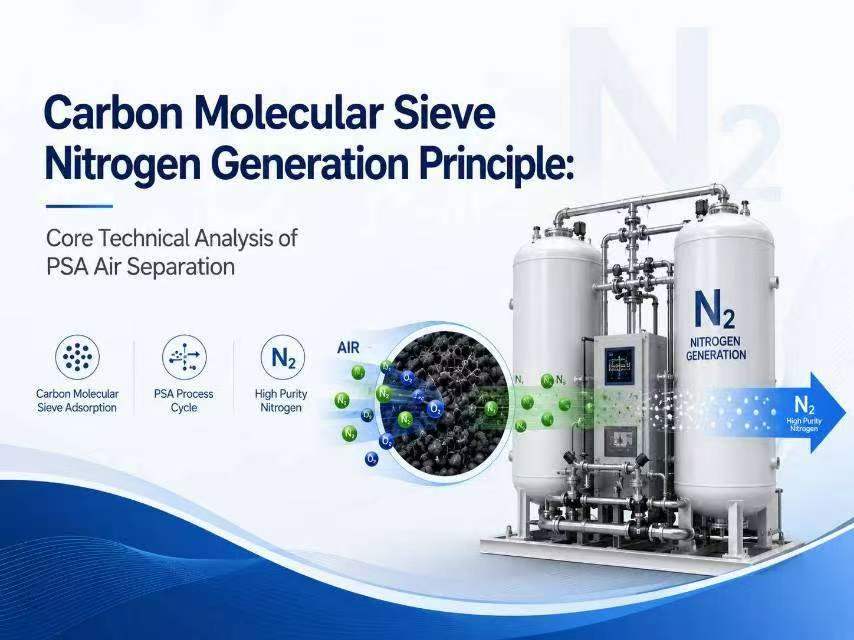
  • Carbon Molecular Sieve Nitrogen Generation Principle: Core Technical Analysis of PSA Air Separation
    Carbon Molecular Sieve Nitrogen Generation Principle: Core Technical Analysis of PSA Air Separation Jun 18, 2026
    1. Core Basics: What is Carbon Molecular Sieve (CMS) Carbon Molecular Sieve (CMS) is a porous carbon adsorption material and the core consumable for PSA nitrogen generators. It features uniformly distributed nano-scale micropores, precisely controlled at 0.28–0.30nm – falling right between the kinetic diameters of oxygen (0.28nm) and nitrogen (0.30nm) molecules, which provides the precise physical foundation for air separation.   2. Core Principle of Kinetic Adsorption Separation CMS-based nitrogen production relies on differences in molecular diffusion rates, rather than physical sieving. After purification, compressed air enters the CMS-filled adsorption tower. Oxygen molecules, being smaller, diffuse faster and are rapidly adsorbed into the micropores. Nitrogen molecules, slightly larger and slower, pass through the bed within the set cycle to yield high-purity nitrogen. This process depends on diffusion time differences, defining it as kinetic separation. Once the micropores are saturated with oxygen, the system depressurizes to desorb and discharge the trapped oxygen, allowing the CMS to regenerate automatically – without heating or chemical agents – for long-term cyclic service.   3. Complete Process Flow of PSA Pressure Swing Adsorption Nitrogen Generation Carbon molecular sieve cannot work independently. It needs to match a dual-tower PSA system to realize continuous nitrogen supply through alternating pressurized adsorption and decompression desorption. The complete nitrogen generation process is divided into four key procedures.   3.1 Air Pre-treatment System (Pre-purification) The air compressor compresses atmospheric air to 0.6-0.8MPa. Then the compressed air passes through refrigerated dryers and three-stage precision filters to completely eliminate dust, liquid water and oil contamination. Moisture and oil are the top threats to carbon molecular sieves, which will cause irreversible micropore blockage, damage adsorption performance permanently and shorten the service life of CMS dramatically. Therefore, a complete pre-filter system is indispensable for standard PSA nitrogen generators.     3.2 Pressurized Adsorption (Core Nitrogen Production Stage)   Purified dry compressed air flows into the CMS-filled adsorption tower. Under high pressure, oxygen molecules are quickly adsorbed into micropores, while nitrogen molecules pass through the tower directly. High-purity nitrogen with a purity ranging from 95% to 99.999% can be produced within dozens of seconds.     3.3 Pressure Equalization (Energy-saving & Protection Process)   After one adsorption tower reaches oxygen adsorption saturation, the system switches automatically and balances pressure between dual towers. Residual pressure inside the tower is recycled to reduce energy consumption for subsequent pressurization. Meanwhile, this process avoids sharp pressure fluctuation to prevent CMS particle pulverization, effectively extending the service life of carbon molecular sieves.     3.4 Decompression Desorption (Molecular Sieve Regeneration)   The saturated adsorption tower is depressurized to atmospheric pressure rapidly. Oxygen and other impurity gases trapped in micropores are fully desorbed and exhausted. The micropores of CMS return to vacant state to finish automatic regeneration. No extra heating device or consumable replacement is required during the whole regeneration process.   4. Performance Comparison: PSA CMS Nitrogen Generation vs Other Nitrogen Production Technologies   Nitrogen Generation Method Start-up Time Operating Cost Applicable Scenarios Max Nitrogen Purity PSA CMS Nitrogen Generation 3-5 minutes for qualified nitrogen output Low, no frequent consumable replacement Most medium and small industrial sites 99.999% Cryogenic Air Separation More than 8 hours pre-cooling time Extremely high, high equipment investment & power consumption Large-scale centralized high-flow nitrogen supply 99.9995% Membrane Separation Nitrogen Generation Instant gas output Medium, membrane modules prone to aging Large-flow demand with low nitrogen purity requirement 99.5%     Considering overall cost performance, flexible start-stop performance and maintenance difficulty, PSA CMS nitrogen generation has become the preferred solution for over 90% of medium and small industrial nitrogen supply projects worldwide.   5. Influence of CMS Quality on Nitrogen Generator Performance   More than 70% of the overall performance of PSA nitrogen generators depends on the quality of carbon molecular sieves. There is a huge performance gap between low-end inferior CMS and industrial high-precision CMS: Inferior Carbon Molecular Sieve: Uneven micropore distribution, poor compression resistance and low oxygen adsorption capacity. It will lead to substandard nitrogen purity, insufficient gas output and increased power consumption, requiring overall replacement within 1-2 years; Our High-precision Carbon Molecular Sieve: Features uniform micropore distribution, high mechanical strength, large oxygen adsorption capacity and excellent oil & moisture resistance. Compatible with full-series PSA nitrogen generators, our CMS boasts a service life of 6-8 years under standard working conditions. Stable long-term gas production effectively cuts power consumption and daily maintenance costs for end users.   6. Our Product Portfolio: One-stop Supply of Full-range Air Separation Adsorbents   With more than 10 years of professional experience in air separation adsorption material industry, our company focuses on the R&D, production and sales of molecular sieves and supporting air separation consumables. Our main product lines cover: Full-series industrial nitrogen generation CMS (CMS 220/240/260/280) Lithium molecular sieve & zeolite molecular sieve for PSA oxygen generators Activated alumina and silica gel desiccants for air drying systems Customized air separation tower fillers and integrated air separation solution services   We support sample trial orders, bulk stock wholesale and customized pore size production. Free technical services including molecular sieve selection guidance and nitrogen generator commissioning support are available. We help nitrogen equipment manufacturers and end industrial users improve gas production efficiency and reduce overall gas supply costs.   7. Frequently Asked Questions      Q: Is regular replacement of carbon molecular sieve required? A: Frequent replacement is not needed under standard working conditions. With well-functioning pre-purification systems, our carbon molecular sieve can serve stably for more than 6 years. Only regular inspection of air compressors and precision filters is required.            Q: Can nitrogen purity be adjusted freely? A: Yes. The nitrogen purity can be adjusted from 95% to 99.999% flexibly by changing adsorption time and working pressure, meeting the nitrogen demand of food packaging, electronic welding, chemical industry and other fields.        Q: Will low ambient temperature affect nitrogen generation efficiency? A: Our PSA nitrogen system works stably within 0-45℃. For outdoor low-temperature working scenarios in cold regions, matched thermal insulation components can ensure stable continuous gas production.   
Qianjiang Industrial Zone, Guichi district chizhou city, Anhui province, China
Quick Links
Subscribe

Please Read On, Stay Posted, Subscribe, And We Welcome You To Tell Us What You Think.

submit
f

Copyright @ 2026 Chizhou Shanli Molecular Sieve Co., Ltd. All Rights Reserved. Network Supported

blog Sitemap Xml Privacy Policy

leave a message

leave a message
If you are interested in our products and want to know more details,please leave a message here,we will reply you as soon as we can.
submit

home

products

Contact Us

Start a Conversation

Hi! Click one of our members below to chat on