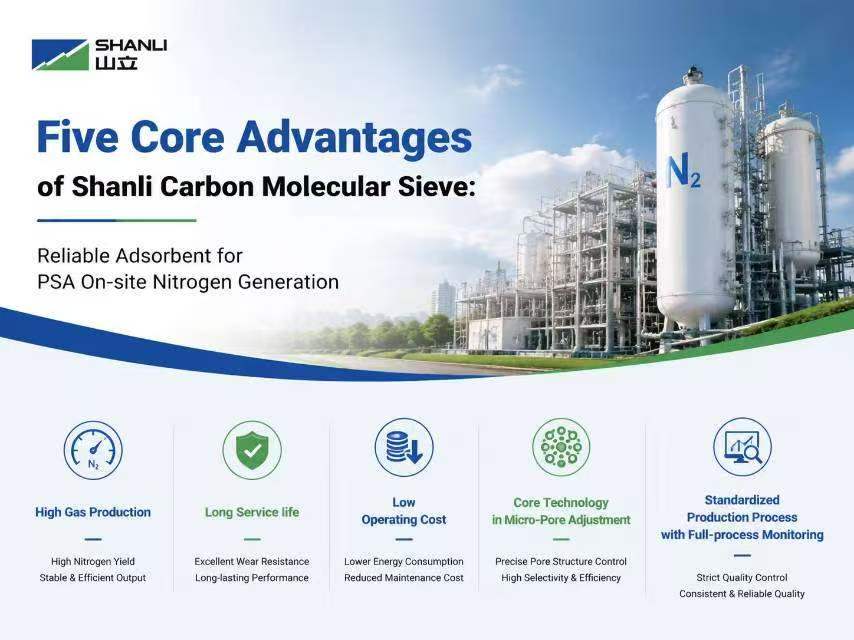
Five Core Advantages of Shanli Carbon Molecular Sieve: Reliable Adsorbent for PSA On-site Nitrogen Generation
Jul 23, 2026
Carbon molecular sieve acts as the core adsorbent for PSA nitrogen generators, directly determining nitrogen output, purity stability, operating expenditure and overall service life of gas production systems.
Shanli carbon molecular sieve is widely adopted across semiconductor, petrochemical, mining and marine industries for on-site nitrogen generation. Supported by proprietary material technology, strict manufacturing control and verified performance data, Shanli CMS stands out amid competitive alternatives. This article elaborates on five core advantages of Shanli CMS, together with our comprehensive supporting technical services for partners and end users.
1. Extended Service Life with Strong Anti-pulverization Performance
Under standard air pretreatment conditions, Shanli carbon molecular sieve features a typical service life ranging from 5 to 10 years. Many customers report even longer operating cycles when equipment and air source conditions are well maintained.
Most Shanli CMS grades achieve a single-pellet crush strength above 38 N, while high-performance customized models can reach over 60 N. Superior mechanical strength effectively reduces particle friction and pulverization caused by continuous airflow impact, vibration and pressure fluctuation, making our products suitable for challenging scenarios including underground mines and ocean-going vessels. Furthermore, customized CMS formulations are available to match various complicated working environments.
2. Lower Long-term Operating Costs Backed by Optimized Air-to-Nitrogen Ratio
The air-to-nitrogen ratio is a decisive indicator that governs power consumption of PSA nitrogen systems. Shanli CMS delivers outstanding separation efficiency, cutting compressed air consumption and reducing electricity expenses for air compressors. Longer service intervals also minimize downtime and maintenance costs caused by frequent adsorbent replacement.
Take SLCMS-USP/L as a reference, tested under 0.7 MPa and 20 ℃ :
For 99.99% purity nitrogen: 110 Nm³ nitrogen per ton of CMS per hour, air-to-nitrogen ratio at 3.5
For 99.9% purity nitrogen: 150 Nm³ nitrogen per ton of CMS per hour, air-to-nitrogen ratio at 2.9
3. Proprietary Micropore Modulation Technology
Micropore structure dominates the oxygen-nitrogen diffusion separation process. Shanli has developed independent micropore modulation technology to precisely adjust pore size and pore distribution of carbon molecular sieve.
With optimized microstructure, Shanli CMS achieves uniform micropores without redundant mesopores. Its adsorption and desorption curves show high coincidence, ensuring stable cyclic separation performance. We are capable of adjusting micropore characteristics according to customers' targeted nitrogen purity requirements, developing tailored CMS grades for different nitrogen production specifications.
4. Standardized Full-process Production Monitoring Based on Premium Raw Materials
Consistent product quality relies on strict control from raw material selection to finished product inspection.
Shanli cooperates with suppliers to develop exclusive resin-based foam precursors specially manufactured for CMS production. Unlike biomass materials, waste materials or recycled feedstock, this premium raw material features low ash content, high consistency and great development potential. High-quality precursors guarantee stable micropore formation during production.
Our quality management covers the whole workflow: raw material screening, pellet forming, carbonization, activation, modification and random sampling inspection. Rigorous full-process monitoring effectively avoids inconsistent performance between batches, ensuring stable quality for every shipment of carbon molecular sieve.
5. High Nitrogen Output Capacity
Benefiting from premium raw materials and mature micropore regulation technology, Shanli carbon molecular sieve delivers higher nitrogen output under the same filling volume compared with conventional CMS.
It can maintain stable nitrogen purity even under relatively high load, supporting large-flow PSA nitrogen generators. This advantage helps equipment manufacturers design more compact nitrogen systems or boost gas production capacity without expanding tower size.
6. Complementary Professional Technical Support
Beyond high-performance CMS products, Shanli provides complete technical services to maximize system efficiency for PSA nitrogen equipment manufacturers and factories requiring adsorbent replacement.
6.1 In-house laboratory testing
We can simulate customers' actual operating conditions, adjust technical parameters and explore the optimal matching scheme to bring out the full potential of Shanli CMS.
6.2 On-site equipment tuning service
Professional technical support is available to optimize operating parameters of PSA nitrogen generators and achieve stable target nitrogen output.
6.3 Sample supply
Samples are offered for preliminary performance verification before bulk orders.
7.Conclusion
Selecting suitable carbon molecular sieve is vital for sustainable and economical on-site nitrogen production. With long service life, favorable operating cost, proprietary micropore modulation technology, standardized full-process manufacturing and high nitrogen output, Shanli CMS provides reliable adsorption solutions for diversified PSA nitrogen projects. Coupled with laboratory testing and on-site technical services, we support partners throughout the whole project cycle.
If you want to learn more details or need sample testing, please feel free to contact us.


 Network Supported