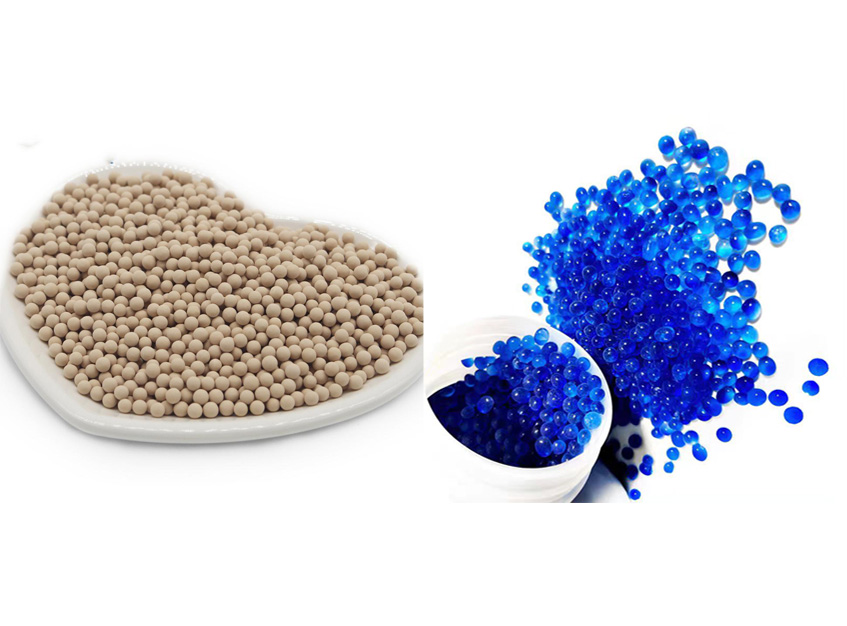
Core Differences Between Molecular Sieves and Silica Gel
Mar 04, 2026
1.Drying Depth
Molecular sieves can stably reduce the gas dew point to below -40°C, with some high‑grade models reaching as low as -70°C, fully meeting deep dehydration requirements. They are widely used in moisture‑sensitive processes such as natural gas dehydration (to prevent pipeline freezing and corrosion), refrigerant drying (to avoid clogging in refrigeration systems), aviation kerosene purification (to ensure fuel stability), and electronic‑grade gas drying (to protect chips from moisture damage). In contrast, silica gel only achieves a drying depth of approximately -20°C, which is limited to general moisture‑proof applications such as preliminary dehumidification in workshops and surface protection of ordinary equipment, and cannot be used for deep dehydration.
2.Adsorption Selectivity
Molecular sieves exhibit strong selectivity. With uniform pore sizes, they can precisely separate molecules of different dimensions—for example, separating oxygen and nitrogen in oxygen generators, and separating normal and isoparaffins in petrochemical processes. Silica gel, however, has no selectivity; it adsorbs various polar substances including water, ethanol, and methanol simultaneously, making it unsuitable for precision separation.
3.Environmental Adaptability
Molecular sieves have excellent thermal stability. Standard grades maintain structural integrity below 650°C and perform reliably in high‑temperature conditions such as petroleum cracking, catalytic reactions, and high‑temperature flue gas treatment. They are also chemically inert and resistant to acids, alkalis, and organic solvents, adapting well to harsh industrial environments.Silica gel has poor thermal stability: its structure collapses and dehydrates into powder above 200°C, losing adsorption capacity and even releasing trace siloxane impurities that contaminate products or corrode equipment. Additionally, silica gel dissolves in strong alkalis and is only suitable for mild, non‑corrosive, room‑temperature applications such as ambient air dehumidification and general instrument protection.
4.Regeneration Performance and Service Life
Molecular sieves require a relatively high regeneration temperature (200–300°C) and supporting heating equipment, resulting in slightly higher initial energy consumption. However, their adsorption capacity is almost fully restored after regeneration; they can be reused more than 10 times, with a service life of 1–2 years (depending on operating conditions), leading to lower cost per unit adsorption capacity over the long term.Silica gel regenerates at a lower temperature (100–150°C) with simpler operation and lower energy use, but can only be regenerated 3–5 times. Adsorption performance degrades noticeably after each cycle, and it gradually powders and fails, requiring frequent replacement. This increases material costs and disrupts production—especially in continuous manufacturing lines, where frequent silica gel replacement causes costly downtime.
5.Cost
Silica gel is much cheaper than molecular sieves, typically priced at 1/3 to 1/2 of the cost, making it suitable for high‑volume, low‑performance general applications.
Selection Summary
Choose molecular sieves for high‑precision, deep drying, high‑temperature, or precision‑separation industrial scenarios (e.g., natural gas, compressed air, petrochemicals).Choose silica gel for room‑temperature, low‑cost applications such as general air dehumidification, instrument moisture protection, and packaging drying.
If you want to get more information about us,you can click www.carbon-cms.com.


 Network Supported