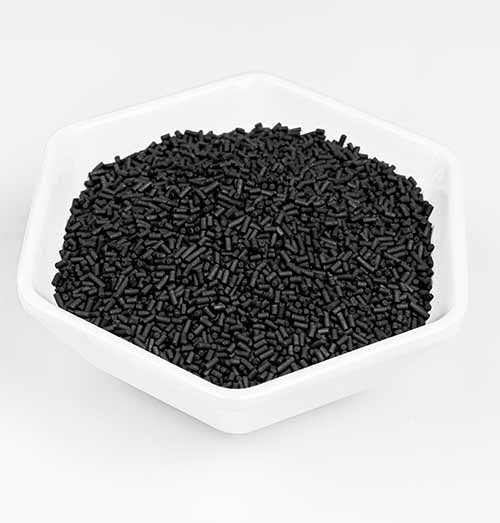
Powdering of carbon molecular sieve
Jan 27, 2026
Powdering of Carbon Molecular Sieve (CMS) refers to the phenomenon where its particles crack and spall to form fine powder during use, transportation or storage. It is a critical issue that impairs the service life, adsorption performance and equipment operation stability of CMS, commonly occurring in the Pressure Swing Adsorption (PSA) process for nitrogen/oxygen generation.
I. Main Causes of Powdering
1. Mechanical Stress
Impacts during Loading, Transportation and Storage: High-altitude dropping during loading and severe jolting in transportation cause collision and extrusion between CMS particles, resulting in surface damage or internal cracks. These cracks expand to form fine powder in subsequent use.
Bed Pressure Difference Fluctuation: Rapid pressure switching during adsorption and desorption in the PSA process leads to repeated expansion and contraction of the CMS bed, intensifying friction between particles and causing atrophy after long-term cycles. Excessively high gas flow velocity will also generate cavitation effects, scouring the particle surfaces.
Equipment Vibration: Sustained vibration of the adsorption tower itself and auxiliary equipment is transmitted to the CMS bed, accelerating particle wear.
2. Improper Operating Conditions
Abrupt Temperature Change: CMS has limited thermal stability. Excessively high heating temperature (above 200℃) during regeneration, or abrupt temperature rise and drop inside the adsorption tower, will cause uneven thermal stress inside CMS and trigger lattice fracture.
Influence of Moisture and Impurities: Excessive moisture in the feed gas causes CMS to absorb moisture, leading to the expansion of pore structure and damage to particle integrity. Moisture can also react with impurities to form corrosive substances that erode the CMS surface. In addition, oil contamination, dust and other impurities in the feed gas will block the CMS pores, causing local overheating or pressure concentration and indirectly exacerbating atrophy.
Adsorbent Saturated Overload: Failure to desorb CMS in a timely manner after it reaches adsorption saturation will cause the accumulation of adsorbate molecules in the pores to generate internal pressure, which cracks the particles.
3. Inherent Quality Defects of the Product
Inadequate Forming Process: Insufficient addition of binders, improper control of calcination temperature or time during production will result in low mechanical strength of CMS particles with poor compression and wear resistance.
Uneven Particle Size and Pore Distribution: Excessively large differences in particle size, or defective pore structures (such as concentrated micropores and wide pore size distribution), will reduce the structural stability of particles and make them prone to cracking under stress.
II. Preventive and Resolving Measures for Atrophy
1. Optimize Storage, Transportation and Loading Processes
Adopt shockproof packaging for transportation to avoid severe jolting; adopt fluidized loading or layered slow loading during filling, strictly prohibit high-altitude dropping, and perform compaction after loading to reduce bed porosity.
Lay stainless steel wire mesh and quartz sand cushion at the bottom of the adsorption tower before loading, and install a pressure net or elastic gland on the top to limit the expansion and contraction displacement of the bed.
2. Strictly Control Operating Conditions
Stabilize the pressure switching rate of the PSA system to avoid abrupt pressure difference; control the feed gas flow velocity within the designed range to prevent cavitation scouring.
Control the regeneration temperature between 150℃ and 180℃ to avoid overheating; the feed gas must undergo pretreatment (cooling, dehydration, deoiling, dedusting) to ensure that the dew point of the gas entering the adsorption tower is below −40℃ and the oil content is less than 0.01 mg/m³.
3. Select High-Quality Carbon Molecular Sieve
Prioritize products with high compressive strength (radial compressive strength ≥100 N per particle) and good wear resistance, and require suppliers to provide forming process and strength test reports.
Select an appropriate particle size (e.g., 3~5 mm columnar molecular sieve) according to operating conditions to reduce stress concentration caused by uneven particle size.
4. Regular Maintenance and Monitoring
Regularly check the pressure difference of the adsorption tower, product gas purity and filter pressure difference. A rapid rise in filter pressure difference indicates intensified CMS atrophy, and the causes must be investigated in a timely manner.
Regularly perform screening and cleaning on the CMS bed to remove accumulated fine powder; replace part or all of the CMS in a timely manner if atrophy is severe.
III. Treatment Plan after Powdering
In case of obvious powdering , take the following steps for treatment:
1.Shut down the equipment for venting, open the manhole of the adsorption tower, and clean up fine powder and damaged particles in the bed.
2.Check whether the pretreatment system (dryer, filter) is invalid, and repair or replace the invalid components.
3.Supplement new CMS and reload and compact it to ensure a uniform bed.
4.Adjust operating parameters (such as pressure switching time and regeneration temperature) to avoid inducing atrophy again.
For more information, please visit www.carbon-cms.com.


 Network Supported